
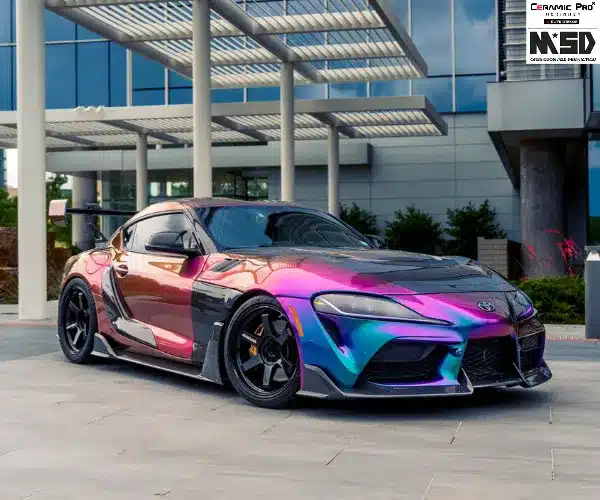
A professionally installed cast vinyl wrap on a daily-driven vehicle lasts between five and seven years, depending on film engineering, surface preparation, installation precision, sun exposure, and washing habits. While manufacturer ratings offer a baseline, real-world durability comes down to how thoroughly the clear coat is decontaminated before application and how well the topcoat is shielded from ultraviolet rays afterward.
1. Film Quality and Material Engineering
Calendered vinyl films are stretched during manufacturing, meaning they carry internal tension that constantly pulls the material back toward its original flat shape. On complex bumpers, deep recesses, and side mirrors, that tension causes edge lifting, cracking, and premature delamination.
High-grade cast vinyl films such as those produced are poured in a liquid state and cured into a thin, conformable sheet without mechanical stretching. Because cast vinyl has virtually zero structural memory, it settles naturally into sharp body lines and panel gaps. Premium cast films also embed ultraviolet absorbers and stabilizers directly into the pigment layer and clear topcoat, preventing chalking, fading, and oxidation during years of highway driving and outdoor parking.
2. Surface Preparation and Paint Condition
Even the highest-grade vinyl fails early if applied over compromised clear coat or microscopic surface contamination. Vinyl adhesive requires direct molecular contact with a clean, stable surface. Wax, ceramic sealants, road tar, embedded iron particles, or silicone dressings act as bond breakers that weaken adhesion along panel edges.
Achieving a multi-year bond requires a clinical preparation sequence before any film touches the paint:
- Chemical Decontamination: Iron removers and tar solvents dissolve embedded metallic fallout and petroleum residues that standard soap leaves behind.
- Mechanical Clay Bar Treatment: Fine-grade clay lifts bonded surface grit until the clear coat is completely smooth.
- Isopropyl Alcohol (IPA) Wipe-Downs: Multiple solvent passes strip polishing oils, lubricants, and skin oils from panel perimeters, door jambs, and wheel arches.
- Paint Defect Inspection: Vinyl conforms tightly enough that rock chips, peeling clear coat, and deep scratches telegraph straight through the finish, and applying film over failing paint guarantees clear coat lift during future removal.
For daily commuters in Prosper, TX, highway grit and seasonal pollen make complete decontamination non-negotiable. Skipping a single prep step often causes edge failure within the first year.
3. Installation Precision and Environmental Control
Prosper vinyl wraps must be installed in a climate-controlled, dust-free bay where temperature and humidity stay within tight tolerances. Cold air makes adhesive brittle and prevents proper wet-out; excessive heat causes the film to over-stretch, thinning the pigment layer and reducing UV resistance.
Experienced installers follow strict mechanical and thermal controls to preserve film integrity:
- Controlled Stretching Limits: Stretching cast vinyl beyond 10 to 15 percent over compound curves stresses the polymer matrix. Technicians feed material into recesses with minimal tension rather than forcing it into place.
- Post-Heating to Glass Transition: After conforming vinyl around bumpers, mirrors, and door handles, installers use infrared thermometers to heat high-tension zones to 190°F–200°F. Post-heating resets the vinyl’s molecular memory, so summer heat will not cause the film to pull back.
- Strategic Panel Wrapping and Edge Sealing: Tucking edges cleanly behind panels and applying edge-sealant tape in high-wash zones stops pressurized water and road grit from creeping underneath.
During a recent inspection on a daily-driven sports sedan from Allen, our technicians traced early bumper lifting directly to un-post-heated film from a budget shop, a failure mode that proper thermal setting prevents.
4. Daily Driving Conditions and UV Exposure
A weekend car stored in a climate-controlled garage absorbs a fraction of the environmental wear that a daily driver faces. Commuter vehicles endure constant solar radiation, thermal cycling, and airborne contaminants.
- Ultraviolet Radiation and Heat: Horizontal panels the hood, roof, and trunk lid take direct overhead sunlight at a 90-degree angle. Prolonged UV exposure breaks down plasticizers in the vinyl, dulling gloss finishes and causing matte or satin films to turn chalky. During North Texas summers, dark roofs regularly exceed 160°F in afternoon sun, accelerating topcoat wear.
- Road Debris and Highway Commuting: Interstate speeds pepper front bumpers, rocker panels, and lower doors with sand, gravel, and bug acids that gradually pit and nick the film.
- Acidic Fallout: Bird droppings, tree sap, hard water sprinklers, and industrial fallout carry corrosive acids and minerals that etch warm vinyl if left sitting for days.
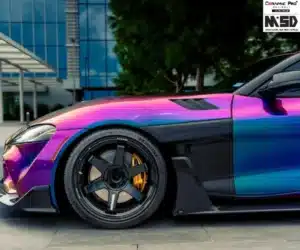
Drivers researching vinyl wraps in Prosper, TX often ask how to protect their finish when covered parking at work is unavailable. Topping a new wrap with a hydrophobic ceramic coating formulated specifically for vinyl blocks UV rays and prevents organic contaminants from bonding to the surface.
5. Washing Habits and Aftercare Routine
Automatic tunnel car washes use stiff rotating brushes and high-pH detergents that scratch soft vinyl topcoats, catch wrapped edges, and strip protective sealants.
Consistent hand maintenance keeps a daily-driven wrap looking fresh for its full lifespan:
- Hand Wash Biweekly: Use a pH-neutral car shampoo, a clean microfiber wash mitt, and the two-bucket method to keep grit from swirling the topcoat.
- Keep Pressure Washers Back: Hold the nozzle 12 to 18 inches away from the vehicle, keep water below 140°F, and never blast directly into panel seams or film edges.
- Spot-Clean Fallout Immediately: Soak and wipe away bird droppings, bug splatter, and fuel drips with a wrap-safe detail spray before sun heat bakes them into the film.
- Skip Paste Waxes and Polishes: Petroleum-based carnauba waxes and abrasive compounds stain matte finishes and haze gloss films. Stick to water-based silica sealants made for vinyl.
6. The Precision Standard Behind Long-Lasting Wraps
MSD Auto Finish is a precision-focused automotive protection and customization studio built for vehicle owners who care about craftsmanship, longevity, and results that hold up over time.
Every service we perform, from full-body color-change vinyl wraps in Prosper to paint protection film and paint correction, is anchored by one nonnegotiable belief: standards never change.
That obsession for protection guides every stage of our workflow, from initial chemical decontamination to final infrared inspection. As both a Ceramic Pro Elite Dealer and an authorized vinyl dealer, our team pairs clinical cleanliness with ongoing education, technical refinement, and continuous improvement. The result is consistent quality without compromise, clear expectations with full transparency, and genuine peace of mind backed by proven methods.
People Also Ask
How long does a vinyl wrap last if a car is parked outside every day?
When parked outdoors full-time in a high-UV climate, a cast vinyl wrap typically lasts three to five years. Horizontal panels like the hood and roof age fastest under direct sun, though applying a vinyl-specific ceramic coating and washing every two weeks can extend usable life by one to two years.
Can you put a ceramic coating over a vinyl wrap to make it last longer?
Yes. A professional ceramic coating engineered for vinyl and paint protection film forms a sacrificial hydrophobic layer over the wrap. It filters UV radiation, repels acidic bird droppings and mineral water spots, simplifies hand-washing, and keeps gloss or satin finishes uniform far longer than bare vinyl.
Will a vinyl wrap damage factory paint when it is removed?
No, provided the vehicle had healthy, fully cured OEM paint before installation and the wrap is removed within its five-to-seven-year window. Leaving an expired wrap on until it cracks or bakes onto the clear coat makes removal labor-intensive and leaves heavy adhesive residue behind.
How much maintenance do Prosper vinyl wraps require compared to factory paint?
Daily-driven wraps require gentler care than factory clear coats because vinyl topcoats are softer than automotive urethane paint. You must skip car washes, hand-wash with pH-neutral soap biweekly, and remove acidic contaminants quickly, but in exchange, you never have to wax or polish your vehicle.
Protect and Transform Your Daily Driver
Your daily commute should never force you to compromise on your vehicle’s appearance or long-term value. Contact us today to inspect your paint, explore finishes, and build a protection plan tailored to how you drive.